Law firm · one rear-end case

One folder arrives.
It bursts into a canvas

Ms. Wang was rear-ended. The police report, medical bills, repair invoice, pay slips — scattered across a camera roll and a dozen chat threads. Send them in as one folder: names and plates become codes first, then the canvas sorts them, builds the timeline, adds up the amounts and points at the one document still missing. What to argue, and how, stays the lawyer's call.

This case is a fictional example, made to show how the canvas handles material. How you keep a real matter confidential is up to you.

Case file · Wang rear-end collision
  1. 01Received
  2. 02Redacted
  3. 03Mapped
  4. 04Gaps
11 items in, scattered across a camera roll and chat threads Names become codes first: Wang Lijuan → A, ZJ A·8F2K9 → Vehicle 1 Timeline: 6 nodes · 3 deadlines · 52,420 verified 1 still missing: proof of lost wages, 9,000 pending
11 items 4 groups 52,420 verified 1 missing
Liability3 Medical3 Property3 Income2 Police report✓ Scene photos✓ Officer notes✓ Medical record✓ Medical bills✓ Review report✓ Damage report✓ Repair bill✓ Tow receipt✓ Pay slips✓ Leave note✓ Proof of wages
Why a canvas

The three things that eat a lawyer's week are not legal questions

Finding documents, stitching a timeline together, and wanting to use AI without sending client material anywhere. We fix the process — not the judgment.

01

A box of files, half a day to find one

You need a three-year-old inspection record before a hearing. It's somewhere across four folders and two chat groups — and once you find it, you still have to check it's the latest version.

02

The timeline is assembled by hand

Who said what, signed what, paid what, and when: scattered across letters, transcripts and bank statements. Typed into a spreadsheet once, re-done every time something changes.

03

Redact before you can touch AI

Names, ID numbers, account numbers, addresses. Two hours of manual replacement, and you still worry you missed one — so you end up doing the work yourself anyway.

One box, several angles

One box of material, several ways to lay it out

A canvas is not one ever-growing diagram. The same cards can be read as a timeline (where the procedure stands), a schedule of exhibits (which page of which volume), an amount sheet (what each head of loss comes to), or a deadline table (what falls due when). Switch the view and the material stays exactly where it was — nothing is re-keyed.

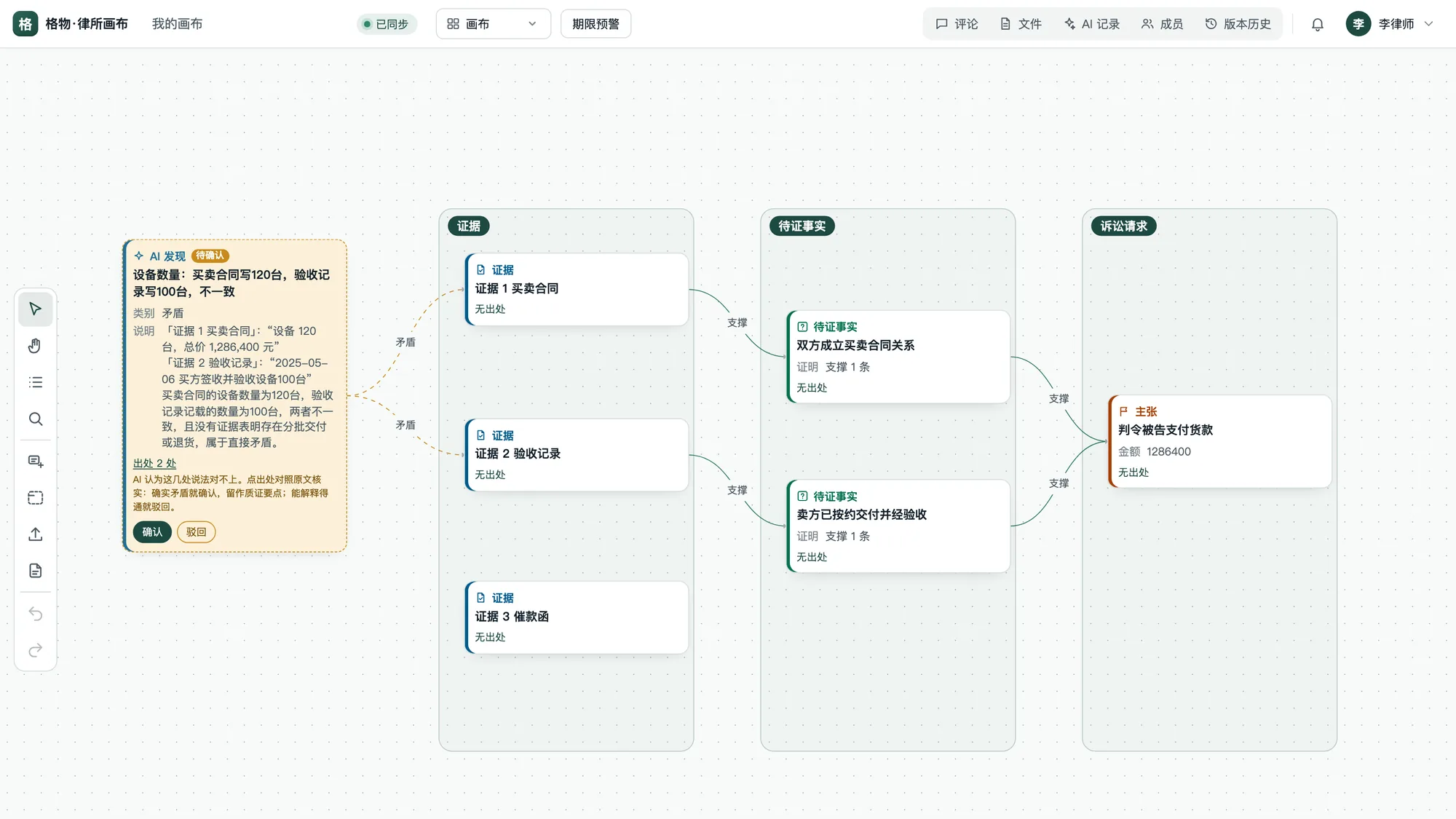
Canvas view: a flagged AI card on the left (two documents disagree on quantity), and three columns — exhibits, facts to be proved, claims — joined by supporting and contradicting links
CanvasExhibits on the left, facts to be proved in the middle, claims on the right. Every edge says whether it supports or contradicts; AI only circles what disagrees — you decide whether to confirm it.
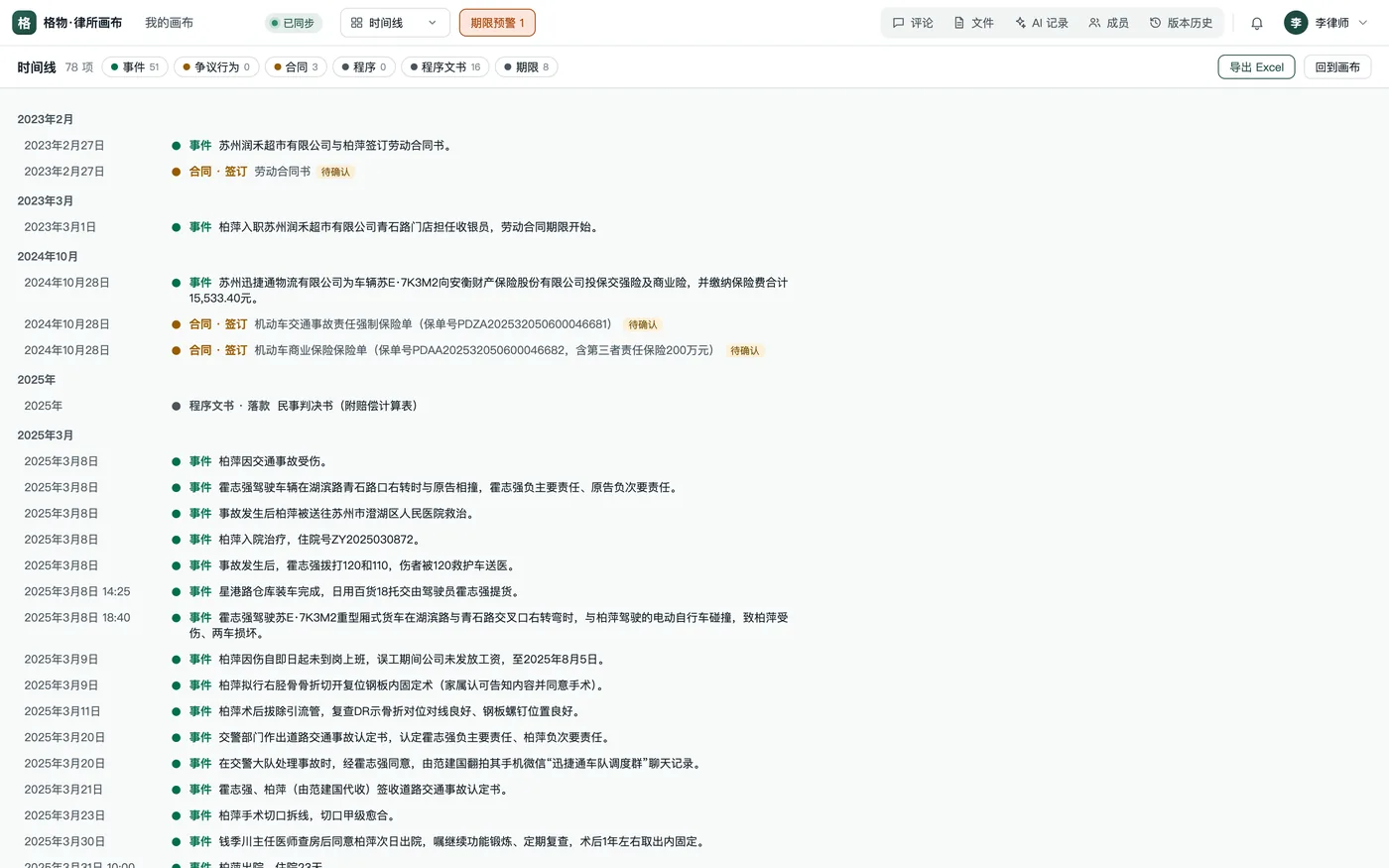
Timeline view: events, contracts and procedural documents grouped by month, unverified items marked as pending
Timeline78 entries in date order, colour-coded by kind. The days nobody accounted for stand out immediately.
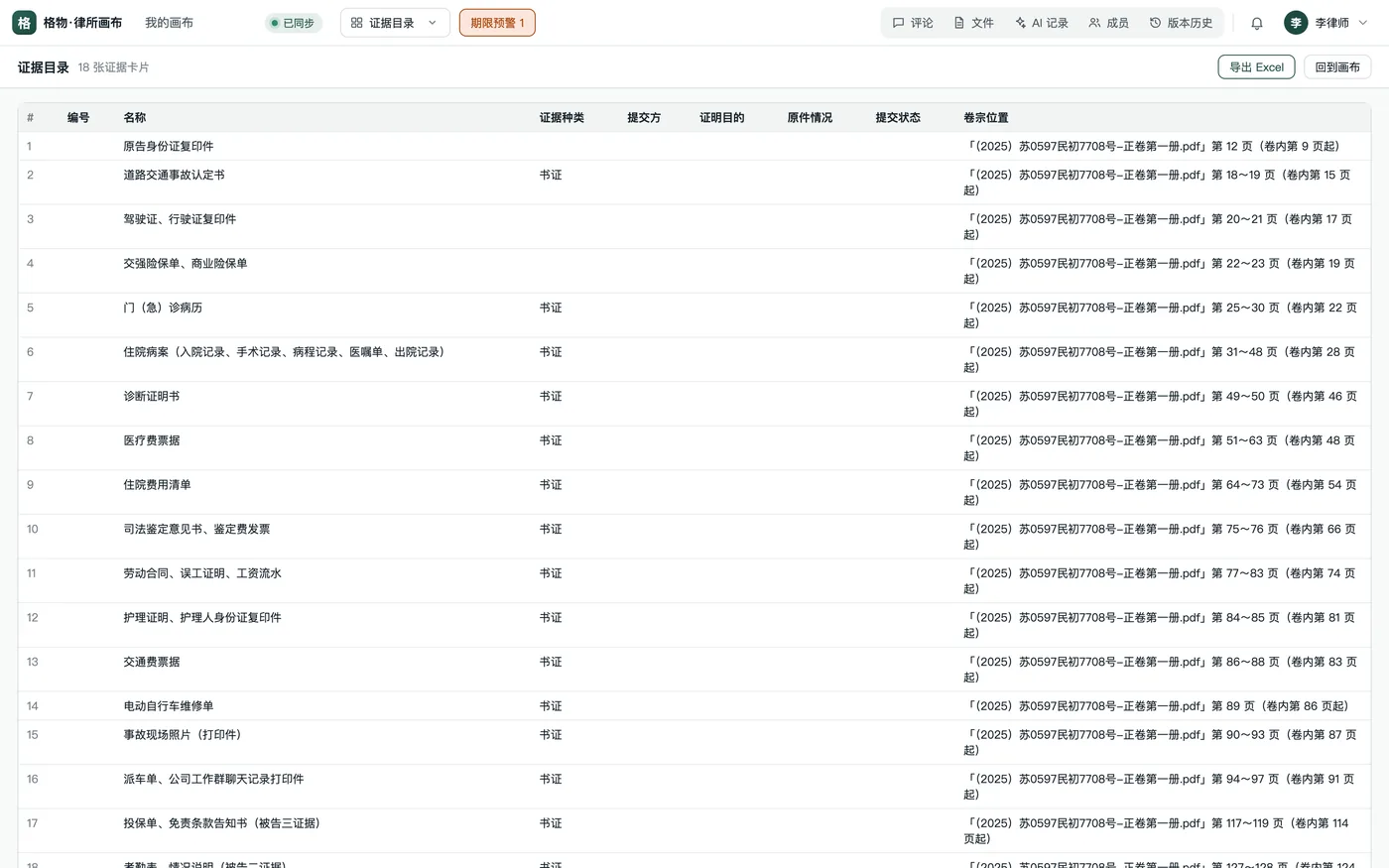
Exhibit schedule: 18 exhibits listed with type, submitting party and the exact page range in the case file
Exhibit schedule18 exhibits with the page range in the file — "volume 1, pp. 34–44" — so nobody goes digging the night before a hearing.
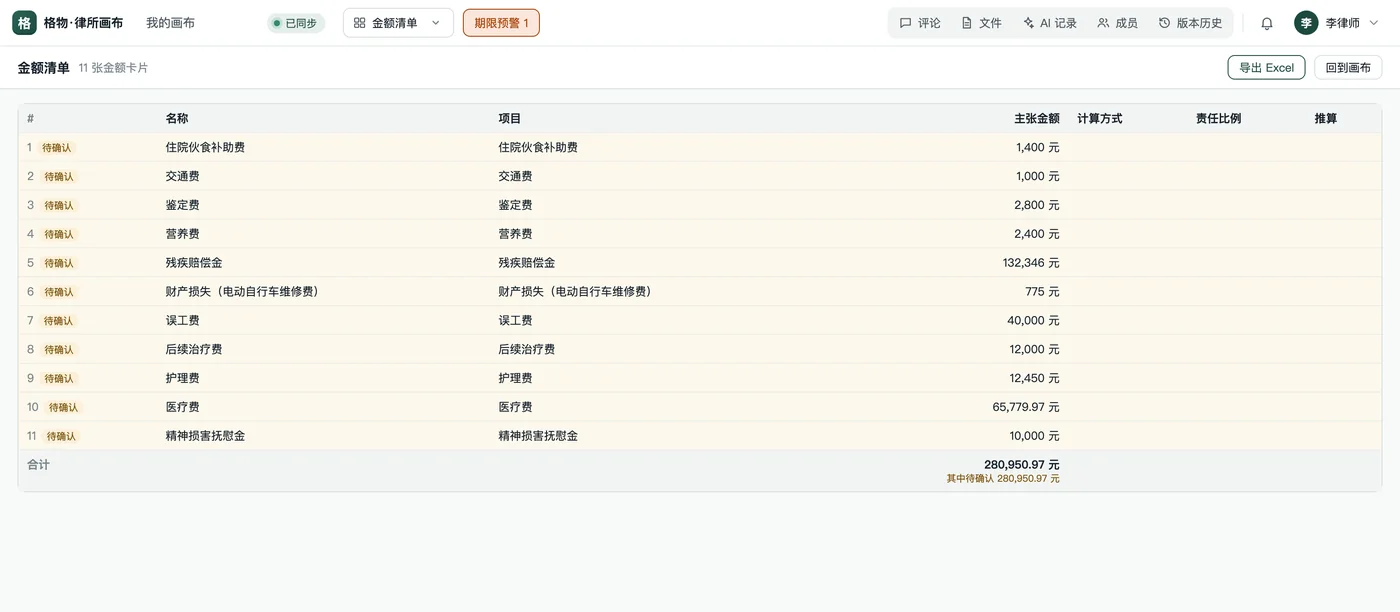
Amount sheet: eleven heads of loss with the claimed amount, the method and the share of liability, plus a total row
Amount sheetEleven heads of loss, each with its method shown next to it, totalling 280,950.87. Anything not yet verified is flagged by you.
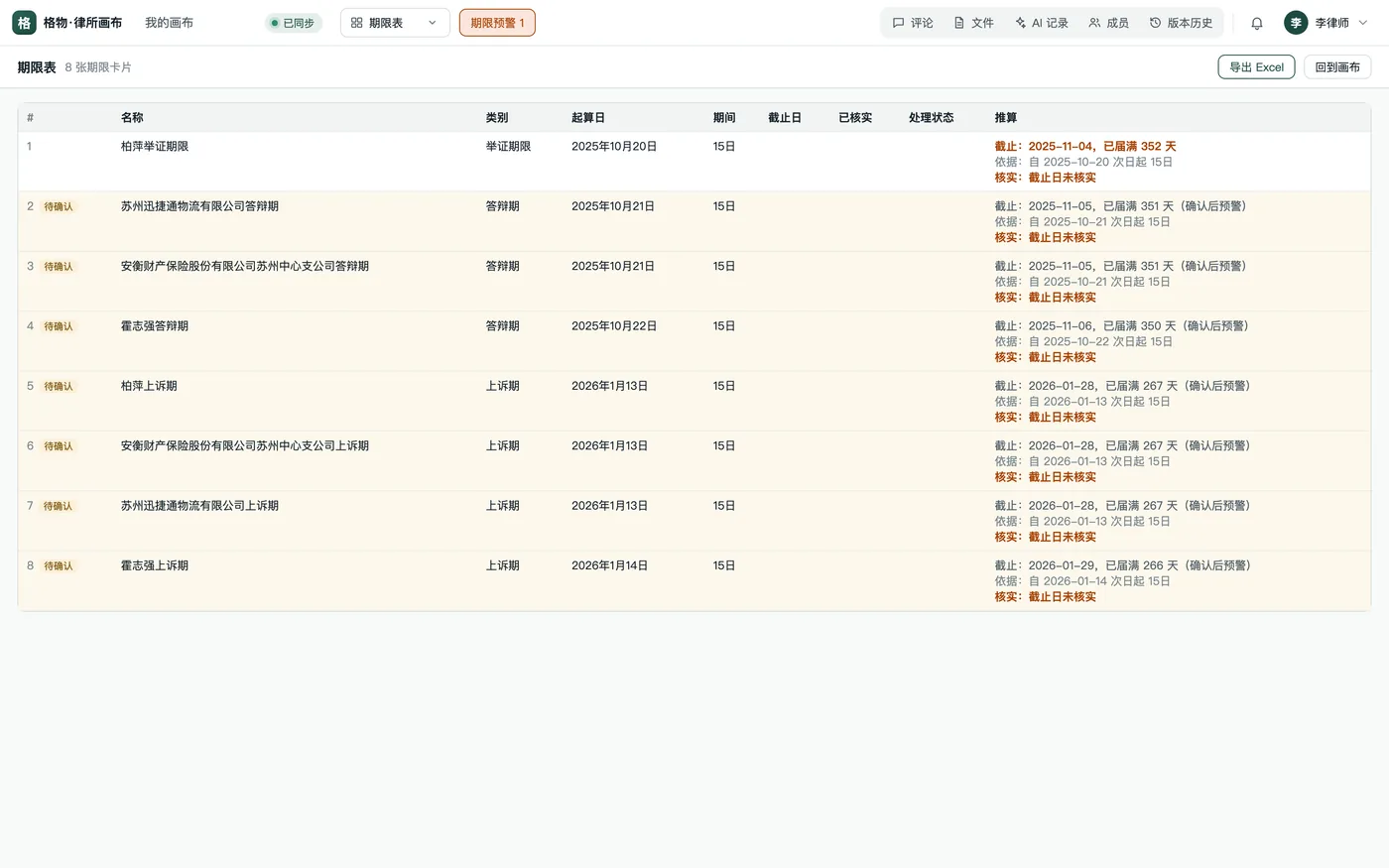
Deadline table: each row shows the trigger date, the period, the due date and the arithmetic, with expired items in red
DeadlinesTrigger date, period and due date worked out together, expired ones in red. A filing window is the one thing you cannot miss twice.

The party graph, asset schedule, comments, files and version history live on the same canvas — open whichever one you need instead of saving yet another spreadsheet to reconcile.

Cases (examples)

Three matters, and how the canvas opens them up

Every one of these is fictional — cause of action, figures and facts belong to no real client. They exist to show the process. In each one we do the same thing: lay the material out, connect what relates, and mark what looks wrong for you to rule on.

Construction · appeal

88 documents, 9 parties, 34 months of a construction dispute

A general contractor and a subcontractor disagree on quantities, now on appeal. The records span nearly three years, and the variation orders, inspection records and payment runs each tell a different story.

88documents
9parties
34months
Document mix
  • Contracts 3
  • Variation orders 26
  • Inspection records 11
  • Correspondence 43
  • Payment records 5

Before

  • Two associates and a paralegal: 11 working days to get through the file
  • The timeline typed into a spreadsheet — one change meant laying it out again
  • Three days before the hearing, still chasing one concealed-works record

On the canvas

  • Everything along the time it happened; click a card and you land on that page
  • Variations, inspections and payments lined up; mismatches marked
  • Switch to the AI view — real names become codes, and that is what a model sees

Flagged by the canvas (yours to confirm)

  • Missing signature3 variation orders signed only by the contractor; the supervisor's column is emptyVariation orders pp. 12, 19, 24
  • Backwards in timeOne inspection record predates the concealed-works inspection it refers toInspection p. 6 ↔ concealed works p. 2
  • Doesn't add upSeven payment instalments, eight progress milestones — one has no payment against itPayment records p. 3

Exhibit index: 11 days → 1.5 daysIssues in dispute narrowed from 11 to 4 — only those are worth writing up

Example: cause of action, figures and facts are fictional, included only to show how the canvas handles material.

Employment · 12 claimants

12 employees, 36 months of payroll, one batch dispute

One company, one set of termination decisions, twelve separate severance calculations. If the method isn't consistent, you get asked about it twelve times — one error becomes twelve.

57documents
14parties
36months
Document mix (including 432 payroll line items)
  • Contracts 12
  • Payroll 12
  • Attendance 12
  • Notices 12
  • Acknowledgements 9

Before

  • Overtime base recalculated by hand for each person: 12 × 36 months
  • Four spreadsheets cross-referenced; one change to the method meant twelve edits
  • Who was missing which document: tracked on someone's notepad

On the canvas

  • Twelve people side by side — start, termination, pay structure, overtime aligned in one row
  • Where the same field used two methods it's flagged, e.g. "overtime base"
  • What's missing is visible at a glance and exports as a follow-up list

Flagged by the canvas (yours to confirm)

  • Method differs3 people's overtime calculated on base salary, the other 9 on gross payPayroll records 4, 7, 11
  • No acknowledgement2 termination notices have no signed acknowledgementNotices 5, 9
  • Gap in records1 person's attendance is missing 4 months, inside the calculation windowAttendance 3

Calculation: 3 days → 40 minutes5 inconsistencies reconciled before the hearing, instead of being asked twelve times

Example: cause of action, figures and facts are fictional, included only to show how the canvas handles material.

Sale of goods · three years of trading

217 orders, 190 delivery notes, one reconciliation

Three years of ongoing trade, never fully reconciled. One side says ¥436,000 is outstanding; the other says it was settled. The disagreement hides in a few dozen unsigned delivery notes.

531records
6parties
38months
Document mix
  • Orders 217
  • Delivery notes 190
  • Statements 24
  • Payment records 100

Before

  • Finance and counsel together, on and off for a month
  • Four spreadsheets: orders, deliveries, statements, payments
  • Limitation periods tracked by someone remembering to check a calendar

On the canvas

  • Orders → deliveries → statements → payments chained; the break is visible
  • Disputed amounts grouped automatically instead of counted one by one
  • Time since the last statement calculated; deadlines approaching get marked

Flagged by the canvas (yours to confirm)

  • Unsigned17 delivery notes with no acknowledgement, ¥436,000 in totalDelivery summary pp. 2–5
  • MatchesThe ¥436,000 reconciliation gap equals those 17 exactlyStatement p. 1
  • Limitation31 of them are 2 years 11 months past the last statementStatement p. 8

Reconciliation: 1 month → 5 daysLimitation flagged a month early, no longer left to memory

Example: cause of action, figures and facts are fictional, included only to show how the canvas handles material.

All three have one thing in common: the canvas never decided anything. It put what belongs together in one place and pointed at what looks wrong. You still sign.

Try it

Paste something of your own

Paste a case summary, a transcript excerpt or a reconciliation note and see how it's broken apart — and how sensitive details become codes. Everything runs in your browser: this page has no backend, and not one byte of what you type leaves the device.

Use an example:

The example is fictional. What runs here is a built-in rule set, not a model — in the product this step is more accurate, and you confirm every line.

Nothing yet. Paste something, or use the button above.

Boundaries

Before you hand anything to AI, settle these four

The first question from a firm is rarely "what can it do" — it's "where does my material go". These four are fixed limits, not options.

Codes, not names

Names, ID numbers, account numbers and contact details become codes like [Person A] before anything reaches a model. The AI view above is exactly what would be sent.

It can run on your own server

Private deployment, on-premise, inside your network. Material doesn't leave your environment and we never touch case content. Cloud is one option, not the default.

Permissions per matter, per person

Who sees which matter, who can edit, who can only read — set to your rules. A trainee and an outside expert don't need the same access.

Audit trail, exportable

Every change to every card is logged. Exhibit indexes, timelines and issue lists export into the formats you actually file.

Tell us about the matter that's costing you the most

No document list, no requirements doc. Just which matter's paperwork hurts the most — we'll build a first version from redacted samples.

No sales calls, no group chats. We answer the one thing you asked.

Leave a line, we'll reply

One line is enough; the rest can stay blank

Or write to us directly

We reply within one business day. Only about the case you wrote about — no calls, no group chats.